
Our P6 PSLE party at Saizeriya

PSLE is over, so we took our P6 students out to Saizeriya on Children’s Day. Inside: ordering everything on the menu, 34 cups of Mountain Dew (the goal, anyway), plate stacking, a triple-digit bill, an alumni drop-in, honest answers to “How was PSLE?”, the envelopes for hitting their marks targets, and the thank-you notes they […]
Our P6 PSLE party, start to end
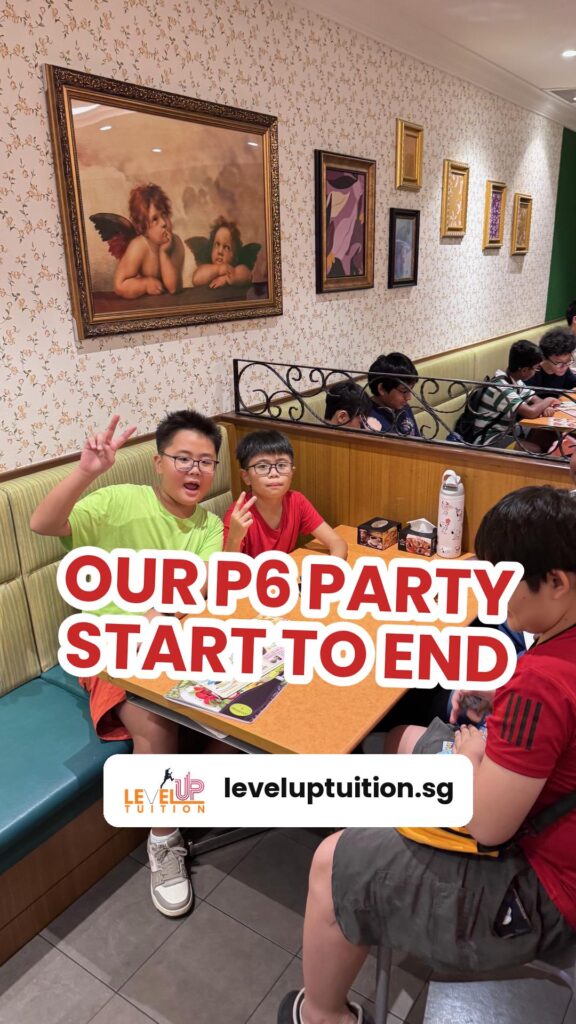
Our P6 graduation party at Saizeriya on Children’s Day, from the drinks rush to the last thank-you note. PSLE is done, so our P6s took over Saizeriya. The drinks rush, a goal of 34 cups of Mountain Dew, a triple-digit bill, the marks-target envelopes and the thank-you notes at the end. Thank you, parents, for […]
PSLE Science: Why You Can HEAR Round A Corner But Not SEE Round One
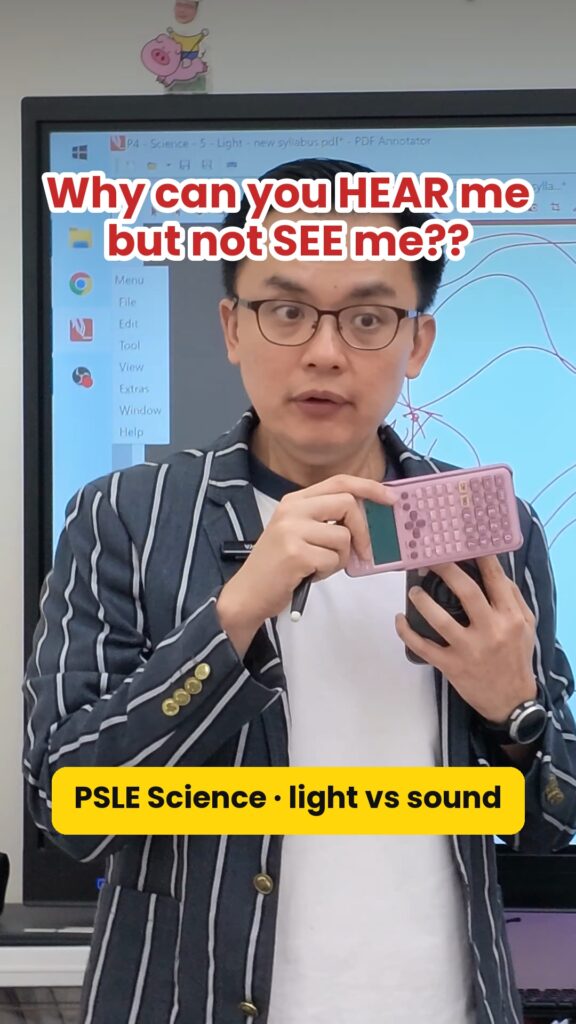
Light travels in a straight line. Sound does not. That one difference explains shadows, and it explains why you can hear someone through a doorway you cannot see them through. In this clip: block the light and you see nothing, because light only goes straight. Block the sound and you still hear everything, because sound […]
PSLE Science: 4 kinds of question that should set off your spidey sense
From our P6 Science class, two days before the PSLE Science paper. Four kinds of question where careful students still lose marks: The word NOT (and “not correct”, “incorrect”) Springs: the question asks for the extension, not the length Ranking: most to least, or least to most? A bulb drawn in the diagram: check where […]
The P6 Maths volume questions in almost every 2026 prelim paper
Quick answer: Two containers, water poured from one to the other. These P6 Maths volume questions appeared in three of nine prelim papers in 2025 and six of nine in 2026, and they carry the biggest questions in the set. The idea that unlocks them is that the amount of water never changes — only […]
Why your child gets P6 Maths angle questions wrong: the picture is lying to them
Quick answer: Six out of every ten marks lost on P6 Maths angle questions come down to two mistakes, and both are about the diagram. Children assume a shape is a square, a parallelogram or a right angle because it looks like one. And they use a number printed on the picture without checking whether […]