
Quick answer: Two containers, water poured from one to the other. These P6 Maths volume questions appeared in three of nine prelim papers in 2025 and six of nine in 2026, and they carry the biggest questions in the set. The idea that unlocks them is that the amount of water never changes — only the height does, and by a different amount in each container.

If you look at only one question type with your child between now and the PSLE, make it these P6 Maths volume questions.
Why these P6 Maths volume questions are hard
Because the amount of water never changes, but the height does — and by a different amount in each container.
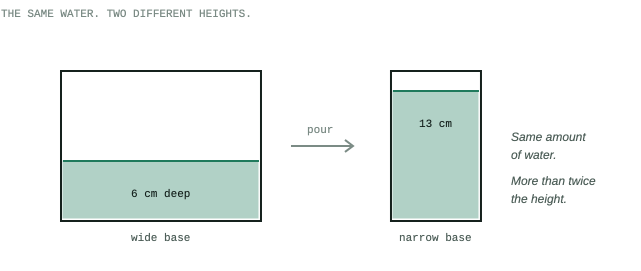
That single idea — work in amount of water, not in height — unlocks nearly all P6 Maths volume questions. The 2026 papers dressed it up several ways:
- Pour from one container into another until the two heights are equal.
- Pour until one height is twice the other.
- Drain one tank while a second fills at the same rate, and ask when they match.
- Pour in a fraction of one tank, and say only how far the other level rose.
The mistake to watch for: averaging the two heights. If one tank is at 6 cm and the other at 13 cm, a child will often write 9.5 cm as the level when they are equalised. That is only right if both containers have the same base — and in these questions they never do.
How to practise P6 Maths volume questions at home
Any two differently-sized containers in the kitchen will do. Fill one, pour it into the other, and ask your child to predict the height before you pour. Getting it wrong at the sink is how the idea sticks: the water is conserved and the height is not.
Then, on paper, make them write down the amount of water as their first line of working, every time, before they touch a height. It feels like an unnecessary step until the question is worth four marks. It is the habit we drill in our P6 Maths programme.
Why these questions grew in 2026
Speed came off the syllabus, and its marks had to land somewhere. Volume was one of the topics that gained — about 13 marks across the nine schools that sat both years. We counted where all of them went in our comparison of the 2026 and 2025 prelims.
Questions parents ask about P6 Maths volume questions
Why does my child average the two heights?
Because height is the number printed on the diagram, so it is the one they reach for. Averaging only works when both containers have the same base area, which in these questions they never do.
What should the first line of working be?
The amount of water, not the height. Once a child writes the volume down first, the rest of the question usually follows.
How common are these P6 Maths volume questions?
They appeared in six of the nine 2026 prelim papers we read, up from three in 2025 — and they carry the two biggest questions in the whole 2026 set.
Do these questions need cubic centimetres?
Usually yes, and a common slip is mixing millilitres and cubic centimetres inside one sum. One millilitre is one cubic centimetre, so convert everything to a single unit before starting.
Is this on the PSLE syllabus?
Yes. Volume of a cube and cuboid sits in the P6 syllabus, including finding a missing dimension from a given volume — which is exactly what these questions ask in disguise.
How this was done: I read every question in eleven 2026 P6 Maths prelim papers and eleven 2025 papers. Counting by hand across the nine schools that sat both years, questions moving liquid between two containers appeared in three papers in 2025 and six in 2026. The diagram above is our own illustration, not a reproduction of any school’s paper.
Want us to work through one of these with your child? Get in touch.