
Quick answer: Six out of every ten marks lost on P6 Maths angle questions come down to two mistakes, and both are about the diagram. Children assume a shape is a square, a parallelogram or a right angle because it looks like one. And they use a number printed on the picture without checking whether it is the angle the question actually needs.
I read the eleven 2026 P6 prelim papers question by question. For every question hard enough to separate students, I wrote down one thing: the mistake a child is most likely to make on it. That is 455 notes in all.
Seventy-seven of them are on P6 Maths angle questions. And forty-seven of those seventy-seven are the same two mistakes. Both are about the diagram.
Mistake one: it looks like a square, so it must be a square
The commonest note I wrote, twenty-two times, is some version of “assumed it from the diagram”. The shape looks like a square, so the child treats all four sides as equal and all four corners as right angles. The question never said that.
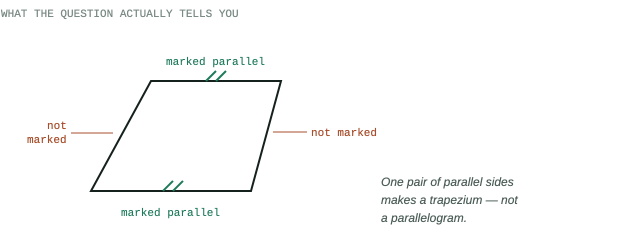
The same trap turns up across P6 Maths angle questions. A triangle that looks isosceles. Two lines that look parallel. A corner that looks like a right angle. In several papers the figure is explicitly not drawn to scale, and the child measures it anyway.
Mistake two: the number is printed, so it must be the number
The second, twenty-five times, is grabbing a value straight off the diagram when the question needs one you have to work out first.
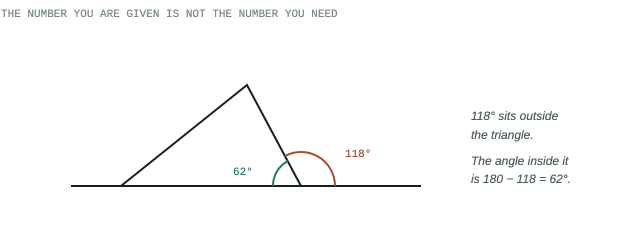
What this sounds like at home: “I used the number they gave me.” That sentence, almost word for word, is the most expensive habit in P6 geometry. A number on the page is a starting point, not an answer.
What to do about P6 Maths angle questions at home
This is one of the few things in P6 Maths that a habit fixes, rather than more practice. Before any angle question, have your child do two things.
Say out loud what the question has actually told them
Not what the shape looks like — what is marked, labelled or stated in words. If “parallel” is not marked, it is not parallel. If the paper does not say isosceles, it is not isosceles.
Ask of every number: is this the angle I need, or a step towards it?
Have them write the angle they actually need beside it, before doing any arithmetic. It takes seconds and it catches the second mistake outright.
Between them, those two habits cover about six in ten of everything that goes wrong on angles. If your child is losing marks in geometry and you only have time to fix one thing, fix this. It is the same reasoning we build into our P6 Maths programme.
Questions parents ask about P6 Maths angle questions
Why does my child get angles wrong when they know the rules?
Because most angle marks are not lost on the rules. They are lost on assuming something the diagram only appears to show. Or on using a printed number that is a stepping stone, not the answer.
Are exam diagrams drawn to scale?
Usually not, and several 2026 prelim papers say so explicitly. A child who measures the figure with a ruler is answering a different question from the one on the paper.
How many angle questions are in a P6 Maths paper?
Angles and geometry carried about 15% of the demanding marks across the eleven 2026 prelim papers we read — the largest single topic in the paper.
What is the fastest way to improve on P6 Maths angle questions?
Two habits, both before any arithmetic. Say out loud what the question has actually stated. Then check whether each printed number is the angle you need, or only a step towards it.
Do these mistakes matter for the PSLE?
Yes. Angles are among the biggest topics by marks, and P6 Maths angle questions in the prelims lean hard on both traps. The two habits above cost nothing to build and they apply to every angle question a child will meet.
How this was done: I read every question in eleven 2026 P6 Maths prelim papers, and for each question demanding enough to separate students I recorded the mistake most likely to be made on it — 455 in total, 77 of them on angle questions. The diagrams above are our own illustrations of the pattern, not reproductions of any school’s paper.
Wondering whether your child has this habit? We are happy to take a look — get in touch.