
If you have ever watched your child solve a word problem with boxes and brackets, you have probably had the same thought many parents tell us: “I never learned it this way, and it looks complicated.”
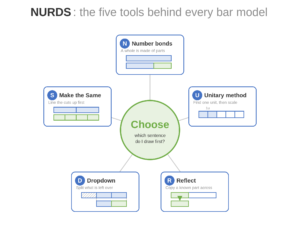
Here is the reassuring truth. Bar models look like dozens of separate methods, but almost everything your child does is built from five simple tools and one skill that ties them together. At LevelUp we give the five tools a name our students remember: NURDS.
- N is for Number bonds
- U is for the Unitary method
- R is for Reflect
- D is for the Dropdown
- S is for making things the Same
In the middle sits the skill that decides which tool to reach for. We call it Choose. Get the choosing right, and the rest is quick.
Let me show you each tool with a real example, then come back to the skill in the middle.
N. Number bonds: a whole is made of parts
This is the very first idea, taught from Primary 1, and it never goes away. A whole is made of parts. If you know the parts, you add to get the whole. If you know the whole and one part, you subtract to get the other.
Example. A class has 32 children. 18 are girls. How many are boys?
The number bond and the bar are the same idea drawn two ways. One whole, two parts.
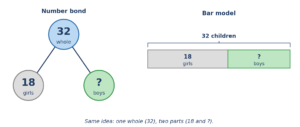
Boys = 32 − 18 = 14.
Every “total and difference” problem, every “how many left” problem, every “two parts make a whole” problem is this same picture. The numbers get bigger and the wording gets trickier, but the move is always the same: parts make a whole.
2. The unitary method: find one unit, then scale
This is the workhorse of upper-primary maths. When a quantity is shared into equal groups, we find the value of one group first, then multiply up to whatever we need. Children write these equal groups as “units,” shown as 1u, 2u, and so on.
Example. Two-fifths of the marbles in a jar are red. There are 40 red marbles. How many marbles are there altogether?
Think of the whole jar as 5 equal units. Red is 2 of them.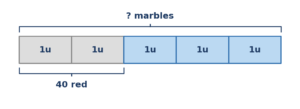
The key step is to get down to one unit before doing anything else:
2u → 40
1u → 40 ÷ 2 = 20
5u → 20 × 5 = 100
So there are 100 marbles.
Notice we never jumped straight from 2 units to 5 units. We always pass through one unit. That single habit, find one first then scale, solves ratio problems, fraction problems, and most rate problems your child will meet.
3. Reflect: copy a known part across
Reflect is for comparison problems where two bars sit side by side and share an equal part. When you know one segment on one bar, you copy it straight across (you reflect it) to the same position on the other bar. Because the bars are lined up, the copy is exactly the same size as the original.
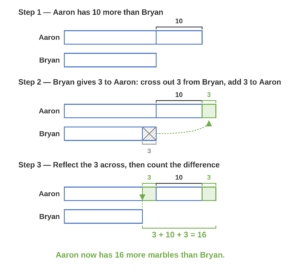
Example. Aaron has 10 more marbles than Bryan. Bryan gives Aaron 3 marbles. How many more marbles does Aaron have than Bryan now?
Draw Aaron’s bar and Bryan’s bar lined up at the left. Aaron’s bar sticks out past Bryan’s by 10.
Now Bryan gives 3 marbles away. Cross out 3 from the end of Bryan’s bar, so Bryan is now shorter by 3. Those 3 marbles go to Aaron, so add a piece of 3 to the end of Aaron’s bar.
Here is the reflect step. Where Bryan’s bar now ends, mark that same point on Aaron’s bar and reflect the missing 3 across. Aaron’s bar, past where Bryan’s bar ends, is now made of three pieces: the reflected 3, the original 10, and the 3 that moved across.
4. Dropdown: split what is left over
This is the one that makes “hard” problems hard, and it is the one parents most often have not seen. But it is still just a simple move. When a problem happens in stages, where something is taken from what remains, we drop down the leftover and treat it as a fresh bar to cut up again.
Example. Mrs Lim had some money. She spent one-third of it on a bag. Then she spent half of what was left on a pair of shoes. After that she had $60 left. How much did she have at first?
Start with one bar for all her money, cut into 3 equal parts. The bag takes one part. Now drop the remaining 2 parts down as a new bar, and cut that into halves for the shoes.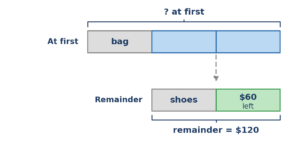
The $60 left is one half of the remainder, so the remainder is $120. The remainder was 2 of the original 3 parts, so:
2 parts → $120
1 part → $60
3 parts → $180
She had $180 at first.
The dropdown is what lets your child handle “and then he spent some of what was left” without panicking. You do not need a new method. You take the leftover, drop it down, and cut again.
5. Make the Same: line two things up before you compare
This is the tool for putting two different-looking things side by side. When two fractions, ratios, or parts are cut into different sizes, we make them the same first. Once they match, we can compare them, add them, or combine them.
Example. Ali spent one-quarter of his money. Ben spent one-half of his money. What fraction did they spend altogether?
Quarters and halves are different-sized parts, so we make them the same. A half is the same as two quarters. Re-cut Ben’s half into quarters, and now both bars are measured in the same parts.
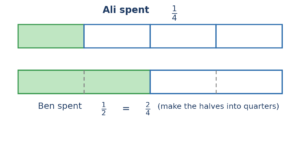
1/2 = 2/4
1/4 + 2/4 = 3/4
Together they spent three-quarters.
Make the same earns its place most when it meets the dropdown. Here is a problem that needs both tools.
Example. Mrs Tan had some money. She spent one-quarter of it on groceries. She then spent two-fifths of the remainder on a dress. What fraction of her money did she have left?
First the dropdown. She spent 1/4, so 3/4 is left. Drop that 3/4 down as a fresh bar. Now she spends 2/5 of it, which means cutting the remainder into fifths. But the money is already cut into quarters, and fifths do not line up with quarters. So we make the same: cut the whole into 20 equal parts, which works for both.
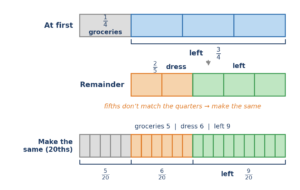
Spent groceries → 1/4, left → 3/4
Make the same → cut into 20ths: 1/4 = 5/20, remainder = 15/20
Dress → 2/5 of 15 = 6 (6/20)
Left → 15 − 6 = 9 (9/20)
She had 9/20 of her money left. Two tools, one problem: the dropdown handles the stages, make the same lines up the cuts.
The skill in the middle: choosing the right sentence
Here is the part that matters most, and the part that takes practice. The four tools are quick to learn. The real skill is reading a word problem and deciding which sentence to draw first.
Start from the wrong sentence and the model turns into a mess. Start from the right one and the tool to use becomes obvious.
The key? Start from sentences that has the words “equal”, “twice”, “three times”, “more than”, or “fewer than”.
If there are more than one to choose from, then start from the first one.
If the words are not in the word problems, then start from the first line. Once you start from the correct sentence, solving the problem becomes much easier.
Watch it all work together
A “difficult” P5 or P6 question is usually not a fifth secret method. It is these same tools stacked in one problem, with the right sentence chosen at each step.
Example. Raju had some stickers. He gave one-quarter to his sister. He then gave 30 of the remaining stickers to his friend, and had 60 left. How many did he start with?
We start from the first sentence: “Raju had some stickers.” Draw one whole bar, then follow each line in order.
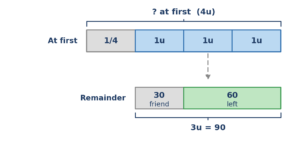
Dropdown: cut the whole into 4, give away 1, drop the remaining 3 parts down.
Number bonds: the dropped-down bar is made of two parts, the 30 given away and the 60 left, so the remainder is 30 + 60 = 90.
Unitary method: that remainder is 3 units.
3u → 90
1u → 30
4u → 120
He started with 120 stickers. One problem, three tools, no magic.
Why this matters for your child
When children think every new question needs a new trick, maths feels endless and frightening. They try to memorise hundreds of “types” and freeze when a question is worded in an unfamiliar way.
When they understand that nearly everything is built from four tools and one skill, the picture flips. There is far less to remember. A strange-looking question becomes “which sentence do I draw first, and which of my four tools does it call for?” That is a calmer, more confident way to think, and it travels with them into secondary school.
So the next time the boxes and brackets look complicated, remember what is underneath. A whole is made of parts. Find one unit, then scale. Drop down the leftover and cut again. Make the two things the same. Four simple tools, and the skill of choosing which sentence to draw first. That is almost the whole of it.