
We went through 221 questions from 13 schools’ 2025 P6 Prelim papers to find the PSLE Math Paper 2 question types that matter most. Five patterns kept showing up. Together they account for 47.7% of all Paper 2 marks, and 65.4% of the marks in the hardest stretch, Questions 14 to 17. A child who can recognise and solve these five has most of Paper 2 within reach.
Why these five questions decide PSLE Math Paper 2
Paper 2 is worth 50 marks, half the subject, and it allows a calculator, so the marks sit in the problem sums rather than the arithmetic. These five patterns are where those marks concentrate, especially in the last four questions where most children lose ground.
The idea we teach is simple. The same method sits behind questions that look nothing alike. The story on top changes every year. The method underneath does not. So we train children to spot the method, not the surface story. Here is one worked example of each, solved the way we teach it.
1. Fraction of the Remainder (spend-and-leftover chains)
A chain of spends or gives-away, where each fraction is taken from whatever is left after the step before. The catch is that each fraction is of a different amount.
Example. Rahmat had some money. He spent 1/4 of it on a book, then 2/3 of the remaining money on a bag. He had $30 left. How much money did he have at first?
Start from the first line and use the dropdown: draw the whole, then drop the remainder down and cut it.
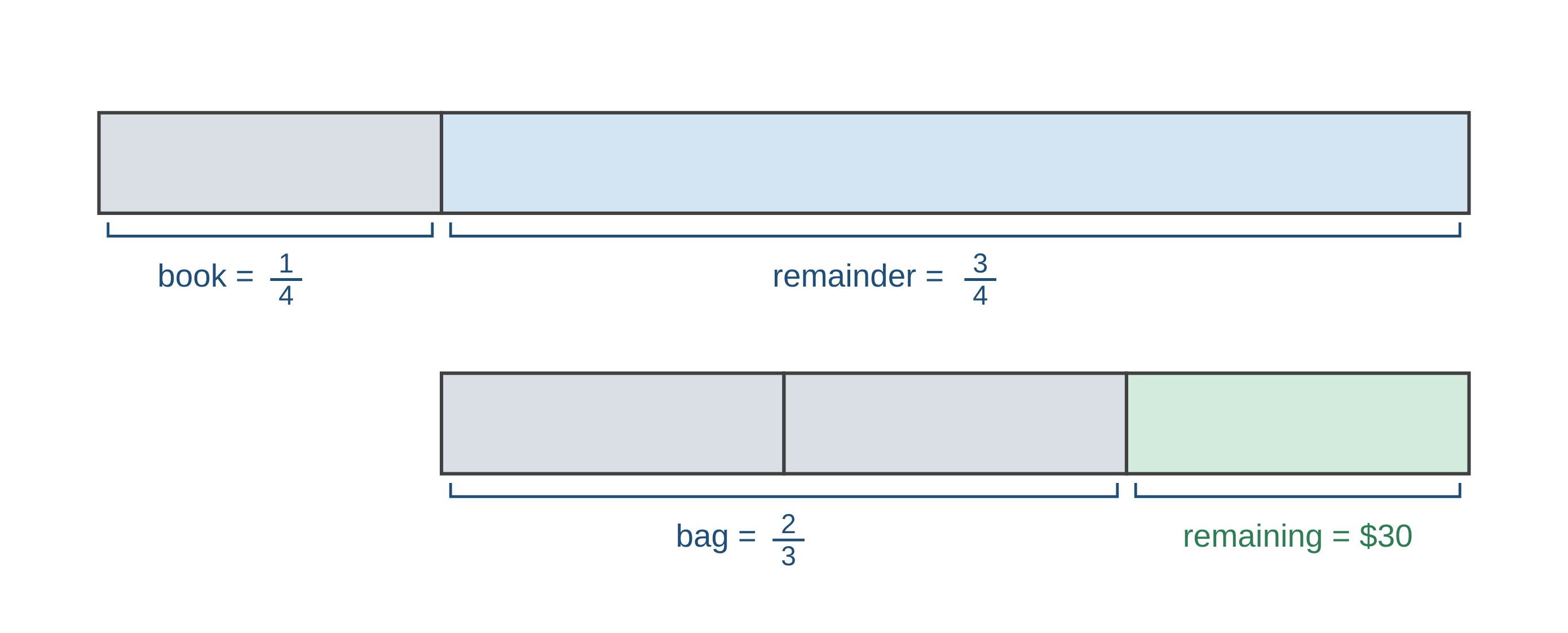
Drop the remainder and cut it into 3: two parts are the bag, one part remains. Each of those parts is a quarter of the whole.
- book → spent 1/4 of the money
- remainder → 3/4 of the money
- bag → drop the remainder, cut into 3, take 2 (that is 2/3 of the remainder)
- each part → 1/4 of the whole
- whole → 4 parts
- remaining → 1 part = $30
- whole → 4 × $30 = $120
Answer: $120.
Method: draw the whole, then drop the remainder down and cut it by the next fraction. The picture turns “a fraction of the remainder” into equal parts you can count, so the units are read off the model instead of multiplied out.
2. Units and Parts (ratio of priced items)
Two quantities are given as a ratio, and each has a price. You combine the count ratio with the prices to reach a total value.
Example. The ratio of pens to erasers in a shop is 3 : 2. Each pen costs $4 and each eraser costs $3. Altogether they are worth $216. How many erasers are there?
Build one set in the ratio, price it with the Each × Number = Total table, then find how many sets fit the total value.
| Item | Each | Number in 1 set | Value |
|---|---|---|---|
| Pen | $4 | 3 | $12 |
| Eraser | $3 | 2 | $6 |
| 1 set | 5 | $18 |
- 1 set → 3 pens and 2 erasers
- 1 set → (3 × $4) + (2 × $3) = $18
- number of sets → $216 ÷ $18 = 12
- erasers → 2 × 12 = 24
Answer: 24 erasers.
Method: keep count and value in separate columns. Price one whole set, divide the total value by the set value to get the number of sets, then scale up to the item the question actually asks for. Never divide down to a single item’s share.
3. Supposition (the coin question and its cousins)
Two types of item, a known total count and a known total value. You assume everything is one type, then correct the gap.
Example. A box has 20 coins made up of 50-cent and 20-cent coins. Their total value is $7.60. How many 50-cent coins are there?
Use the Assumption Method, assuming the opposite of what the question asks, so the final division lands straight on the answer. There is no diagram for this type. The four lines below are the method, and they stand on their own.
- assume all 20 are 20-cent → 20 × $0.20 = $4.00
- big difference → $7.60 − $4.00 = $3.60
- small difference → $0.50 − $0.20 = $0.30 per swap
- number of 50-cent coins → $3.60 ÷ $0.30 = 12
Answer: 12 fifty-cent coins.
Method: assume every item is the type you are not asked for. Find how far the assumed value sits from the real total (the big difference), work out how much one swap changes the value (the small difference), then divide. Because you assumed away the coin you want, the answer comes out directly, with no final subtraction.
4. Angles in Figures (parallelograms and triangles)
Find an unknown angle by chasing it through the figure, using one property of the shape together with the angle sum of a triangle.
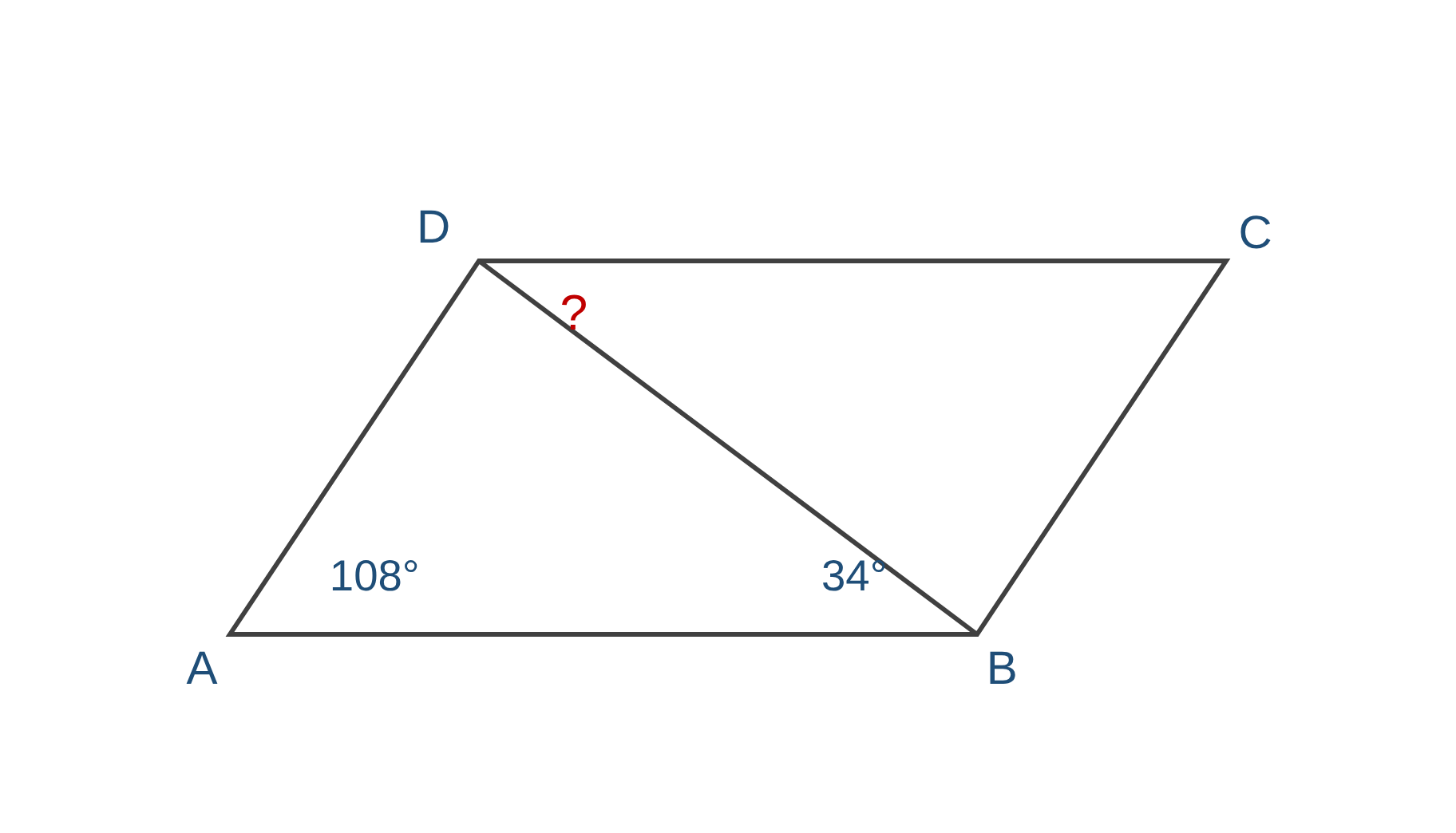
ABCD is a parallelogram (figure not to scale).
Example. ABCD is a parallelogram. Angle DAB = 108° and angle DBC = 34°. Find angle BDC.
- angle BCD → angle DAB = 108° (opposite angles of a parallelogram are equal)
- triangle BDC → three angles add up to 180°
- angle BDC → 180° − 34° − 108° = 38°
Answer: 38°.
Method: pick the triangle that contains the angle you want, then unlock it with one parallelogram property (opposite angles equal, or co-interior angles adding to 180°). One property is usually all it takes.
5. Circles with Area and Perimeter
A shaded region built from a square and part of a circle. You find the area, the perimeter, or both.
Square ABCD with a quarter circle of radius 14 cm removed from corner A (figure not to scale).
Example. The figure shows a square of side 14 cm. A quarter circle of radius 14 cm is drawn from corner A and removed. Find (a) the area and (b) the perimeter of the shaded region. Take π = 22/7.
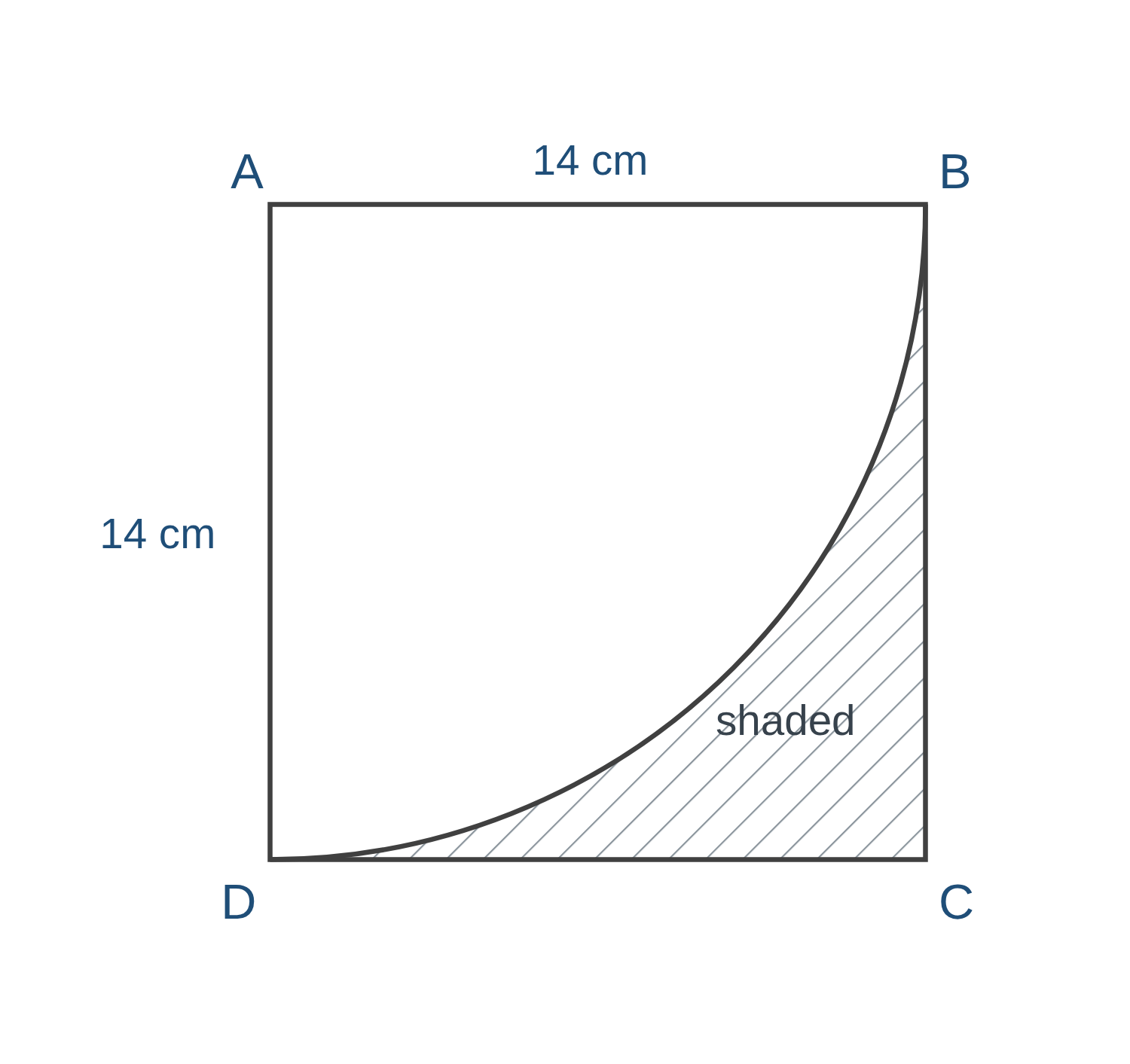
(a) Area
- square → 14 × 14 = 196 cm²
- quarter circle → 1/4 × 22/7 × 14 × 14 = 154 cm²
- shaded → 196 − 154 = 42 cm²
(b) Perimeter
- boundary → two straight sides + the arc
- two sides → 14 + 14 = 28 cm
- arc → 1/4 × 2 × 22/7 × 14 = 22 cm
- perimeter → 28 + 22 = 50 cm
Answer: (a) 42 cm² (b) 50 cm.
Method: for area, take the whole shape and subtract the circle part. For perimeter, trace the actual boundary of the shaded region, the straight edges plus the arc, not the four sides of the square.
How to practise the PSLE Math Paper 2 question types
Recognition comes before speed. Start by drilling each type on its own until your child names the method on sight, then mix the five together so they have to decide which one a question is asking for. That decision, not the calculation, is what the hardest Paper 2 questions test. When a question looks new, the first move is always the same: strip away the story and ask which of these methods fits.
If you want structured practice built around these methods, that is what we teach at LevelUp Tuition.
PSLE Math Paper 2: questions parents ask
How many marks is PSLE Maths Paper 2?
Paper 2 is worth 50 marks and lasts 1 hour 20 minutes, and a calculator is allowed. It carries 17 questions, five short-answer and twelve longer problem sums, and it counts for half of the overall Mathematics grade. Paper 1, the non-calculator paper, makes up the other 50 marks.
Which Paper 2 questions are the hardest?
In the 2025 Prelim papers we analysed, the last four questions, 14 to 17, held the most marks and the most difficulty. The five question types on this page account for 65.4% of the marks in that stretch, which is why we drill them first.
Do the same question types appear every year?
The exact numbers and stories change, but the underlying methods repeat. That is the whole point of teaching the method rather than the question: a child who recognises the pattern can solve a version they have never seen before.
These five PSLE Math Paper 2 question types are worth drilling until your child recognises them on sight. For the full breakdown of how often each one appears, see our PSLE Math Paper 2 patterns analysis.