
Quick answer: Three things changed in the 2026 P6 Maths prelims. Speed disappeared, and its marks moved into fractions, volume and area. Ratio nearly halved in weight and got far easier, because ratio is no longer taught in P5. And the hard before-and-after questions moved out of ratio into whole numbers and percentage. The papers are not harder than 2025 — they are shaped differently.

So I read every question in eleven top-school 2026 P6 Maths prelims, then read the same schools’ 2025 papers beside them. That is 920 questions, marked up one by one. Nine schools sat both years, so those nine are the fair comparison.
Most articles about this year’s changes explain the syllabus, which the Ministry already explains for free. This one counts the marks in the real papers instead. If you want the format changes rather than the question-by-question findings, we covered those in what changed in 2026 PSLE Maths Paper 1.
Change 1: The speed marks went to fractions, volume and area
First, speed. It has gone from the syllabus, moving up to Secondary One, and most parents know that by now. What nobody has told you is where its marks landed.
In the 2025 papers, speed was worth about one mark in every twenty-four of the demanding marks. In the 2026 P6 Maths prelims it is worth none. That is true of every single paper I read. But a paper is still a hundred marks, so those marks had to go somewhere:
| Topic | 2025 | 2026 | Change |
|---|---|---|---|
| Fractions | 8.8% | 10.9% | +15 marks |
| Volume | 5.5% | 7.4% | +13 marks |
| Area & perimeter | 5.4% | 7.2% | +13 marks |
| Graphs & tables | 6.1% | 7.7% | +11 marks |
| Whole numbers | 8.8% | 9.9% | +8 marks |
| Number patterns | 2.7% | 3.8% | +8 marks |
Nothing exotic, then. The freed-up marks went straight back into topics your child has been doing since P4, but asked in harder, longer ways.
The volume questions show this best. One school pours water between two containers with different bases and asks when the heights match. Another drains one tank while a second fills at the same rate. In other words, these are not “find the volume of the cuboid”. They are three or four ideas stacked up, wearing a familiar topic’s clothes.
Change 2: Ratio is now a one-year topic, and the hard ratio question nearly vanished
Second, ratio. This is the change that took me longest to understand.
- Ratio fell from 9.8% of the demanding marks to 6.1% — twenty-six marks gone.
- Of the ratio marks, the share needing real insight fell from 68% to 21%.
- In 2025, every one of the nine schools set at least one genuinely hard ratio question. In 2026, only three did. Six schools set none at all.
- The biggest ratio question in the whole 2026 set is worth three marks, whereas last year there were four-markers.
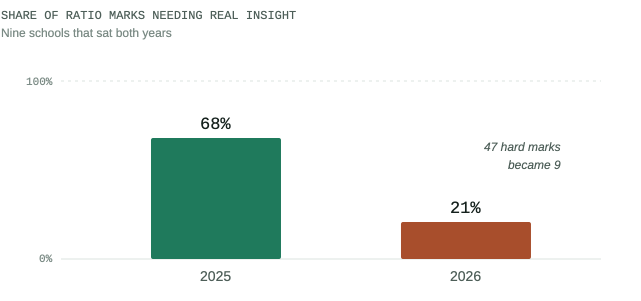
The reason is the syllabus, but not the part everyone talks about. Ratio used to be taught in P5 and again in P6. It is now a P6 topic only. This cohort has therefore had one year with ratio where the year above had two.
And nine schools independently pitching ratio lower is not nine coincidences. It is nine schools reading the same situation the same way: you cannot ask a class that met ratio a few months ago to do the problems you would set a class that met it eighteen months ago.
What a hard ratio question used to look like
You can see it in the questions themselves. Last year’s ratio was the classic grade-decider: read-to-unread pages after 195 more get read; two teams where a quarter of one and three-sevenths of the other are girls; ages four years back and eight years on. This year’s are mostly chaining — squares to triangles is 1 : 4, squares to circles is 2 : 3, now find triangles to circles. That is a procedure, so a child can be taught it in an afternoon.
One honest caveat. We do not know whether the PSLE will pitch ratio as gently as the schools did. The prelims are the schools’ best guess, and nine of them guessed the same way. However, the PSLE is set nationally, and the P6 ratio content itself has not been cut. We would teach ratio properly and not gamble either way.
Change 3: In the 2026 P6 Maths prelims, the hard thinking moved out of ratio
Third, and this is the part to act on: before-and-after problems have not gone anywhere. These are the questions where something is given away, transferred or added, and the total shifts. Instead of disappearing, they changed topic.
In 2025, five of them were ratio questions. In 2026, only two. The rest now turn up as whole-number and percentage questions: Judy gives 26 sweets to Lindy and Lindy then has five times as many; a shopper exchanges ten dollars of coins for notes; a shop sells only mangoes and its total stock falls by 20%.
Same thinking. Different label. So a child drilled on “ratio before-and-after questions” who does not recognise the same shape in a whole-number question will still lose those marks.
What the 2026 P6 Maths prelims did not change: the papers are not harder
There is a lot of anxiety about being the first cohort under a new syllabus. Our numbers, however, do not support it.
I rated every demanding question on how much genuine insight it needs, as opposed to a practised method. In 2025 the hardest category carried 46.5% of the demanding marks. In 2026 it carried 44.2%.
That is flat. The 2026 papers are not harder than the 2025 papers. They are shaped differently. So a child struggling this year is struggling with different topics, not a tougher exam.
What we would revise, in order
- Fractions and measurement, in long multi-step questions. This is where the new marks are. Short fraction sums will not prepare a child for a four-mark question that hides a fraction inside a pricing problem.
- Before-and-after problems — in every topic, not just ratio. This year they are hiding in whole numbers and percentage.
- Volume with water poured, drained or moved between containers. This turned up in paper after paper, and it carries the biggest questions in the set. It is one of the patterns we drill in our P6 Maths programme.
- Ratio, at the level it is now taught. Do not over-invest, but do not drop it either, because nobody has seen the PSLE yet.
- Stop drilling speed. It is not coming back this year.
Questions parents ask us about the 2026 P6 Maths prelims
Is speed really gone from the PSLE?
Yes. Speed has been removed from the primary syllabus and now starts in Secondary One. It appeared in none of the eleven 2026 prelim papers I read.
Are the 2026 P6 Maths prelims harder than 2025?
No. The share of marks on questions needing real insight was 46.5% in 2025 and 44.2% in 2026. The papers changed shape, not difficulty.
Should my child still study ratio?
Yes. Ratio is still fully examinable, and the syllabus lists seven sub-topics of it at P6. Schools set easier ratio questions this year because ratio is now taught only in P6, but the PSLE is set nationally and may not follow.
Which topic gained the most marks in the 2026 P6 Maths prelims?
Fractions, up about 15 marks across the nine schools that sat both years. Volume and area and perimeter each gained about 13.
Why did ratio get easier in the 2026 P6 Maths prelims?
Because ratio moved out of the P5 syllabus. This cohort has had one year with the topic instead of two, so schools pitched their questions lower.
How many papers did you actually read?
Eleven of the 2026 P6 Maths prelims and eleven 2025 papers, from top Singapore primary schools. I recorded 920 questions in total.
How this was done: I read the questions in eleven 2026 P6 Maths prelim papers and eleven 2025 papers, and recorded the printed mark and topic for every question demanding enough to separate students — 920 questions in all. The percentages describe those demanding questions, not the whole paper. The nine schools that sat both years are the basis for every year-on-year comparison. Syllabus content was checked against MOE’s Primary Mathematics Syllabus, Primary 1 to 6, the 2021 syllabus as updated in October 2025.
Wondering how your own child is placed against this? We are happy to talk it through — get in touch.