
Right now, across a lot of dinner tables, the same conversation is happening. The P6 Science WA2 results came back, the mark was lower than expected, and a parent who knows their child works hard is quietly worried that something has gone wrong.
If that is you, this is worth two minutes of your time. Because in most cases, nothing has gone wrong at all.
Was the P6 Science WA2 really that hard?
We read this year’s P6 Science WA2 papers across several schools and lined them up against the actual prelim and PSLE standard. The tougher papers were not gentle, term-time assessments. Question for question, they were pitched at prelim level.
Do not take our word for it. Here is a question in the same style as one that appeared this year. Try answering it yourself before reading on.
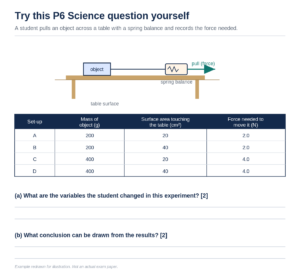
Most adults stall on part (b). The trick is that two things change at once, the mass of the object and the surface area touching the table, so the child has to separate the effect of each. Comparing the set-ups, doubling the surface area makes no difference to the force, while doubling the mass doubles it. The conclusion is that the force needed depends on the mass, not on the surface area in contact. That is not “do you remember what friction is.” It is controlled-variable reasoning, the exact skill the prelims and the PSLE are built to test. Children were being asked to do it in May.
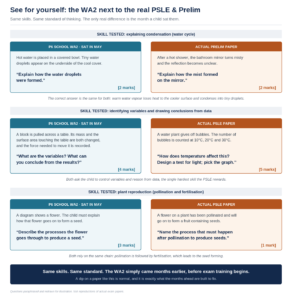
And it is not a one-off. Here are three questions from this year’s WA2 papers placed beside the actual prelim and PSLE. The skills are identical.
Why a strong, hardworking child still dips
Here is the part that gets missed. Most children met questions like these before they had been trained to answer them.
Finishing the syllabus and being ready for an exam are two different things. Finishing the syllabus means a child knows the content. Being exam-ready means they have been drilled on how to convert that knowledge into marks under time pressure, using the right structure and the right keywords. That second skill takes months of deliberate practice to build, and at WA2 time it has barely started.
So picture a capable child who knows the material, writes plenty, and thinks well, walking into a prelim-level paper with the knowledge in place but the exam technique still unbuilt. A dip is not a warning sign. It is the predictable result of meeting hard questions early, before the training those questions are designed to reward.
The qualities that matter most are the ones a tutor cannot install: working hard, thinking clearly, and being willing to put answers on paper instead of leaving blanks. When those are already there, the rest is training. And training is fixable.
The timeline that scares parents, and why it shouldn’t
Three months to prelims. Five to the PSLE. On paper that sounds tight, and that is where a lot of the worry comes from.
But the months ahead are nothing like the months behind. The intensity changes gear completely. From June onward, P6 shifts into heavy exam practice: full-length papers, timed conditions, application questions drilled topic by topic, every mistake reviewed and then re-tested until it sticks. A child will sit more papers in the next three months than in the entire year up to this point. You cannot compare the two periods, and you should not try to.
By the time the prelims arrive, the child who struggled with this WA2 will be a far more practised, far more exam-hardened version of themselves. That is not optimism. It is what that block of time is built to do.
What this WA2 is actually for
Read it as a starting line, not a verdict. A hard, honest paper sat early tells us exactly where to push while there is still plenty of road left to push. A paper that was too easy would have told us nothing and given everyone false comfort.
This is the part of the year our P6 programme is built around. It’s Fun. And It Works. Lessons that keep children engaged and willing to try, backed by systems that turn “I’ve seen this before” into “I can answer this under exam conditions.” The knowledge is the start. The training is what turns it into a result.
So if the WA2 mark wobbled, take the breath. The work that closes the gap is exactly the work that is about to begin.