
PSLE extra lessons do two things the weekly lesson has no room for: more practice under exam conditions, and second attempts at questions the student got wrong.
All our extra lessons are timed practice + second attempts.
Science: sit full papers, meet more question types
Many P6 students have not sat a full Science paper since P5 EOY. They have done topical worksheets and revision sets all year. A full paper against the clock is a different thing. Prelims is a bad place to find that out.
So students sit full papers under time. That builds pacing and stamina. It also builds exposure, which matters more.
An example. Two set-ups collect pure water from sea water. Both have a clear glass cover. One tray is painted black, one white. Explain how the water is collected, then say which set-up collects more and why.
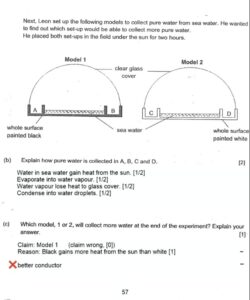
First time, this is hard. There is no topic label. It looks nothing like the textbook diagram. The student has to see that it is evaporation and condensation, then write a claim and a reason in the right form.
Tenth time, it is routine. Students cannot tell a hard question apart from an unfamiliar one. Only volume sorts that out.
We also know which questions cost marks. We went through one year of Prelim papers from ten schools and pulled out every difficult question. 266 of them, each tagged by topic, by how many steps it needs, and by the trap it sets.
Only 12 of the 266 can be done in one step. A third are top difficulty. The traps repeat:
- Tracing a diagram, graph or circuit: 52 questions
- Confusing what is observed with what is true: 38
- Running a process backwards: 32
- Overgeneralising from “all”, “only”, “always”: 31
- Right fact, wrong question: 30
- Multi-step inference from data: 29
- Surface properties confused with conduction: 21
The black and white trays sit in that last family. Students write that black is a “better conductor”. The answer is that black gains heat from the sun faster than white. That is a habit, not a knowledge gap, and habits change through repetition.
This is why we build in the second attempt. In most classrooms a wrong answer gets marked, corrected and explained. The student nods. They have still never written a correct answer to that question. In our extra lessons they rework it in their own words on paper, and it comes back later if it is still weak.
Maths: drill the structures that repeat
For Maths we do not use more school papers. Students work through our own word problem worksheets.
PSLE word problems repeat. Not the numbers or the stories, the structure underneath. Sweets shared among children and money spent at a fair can be the same problem. Strong students see this. Weak students do not, so every question starts from zero.
So we teach the structures directly. One worksheet drills one structure, across questions that get harder, with the same thinking move every time.
They are named, not vague. P6 Fractions alone has Remainder Reversal, Peel-Back the Remainder, Compare the Leftovers, Fraction of a Fraction, Whole then Split the Rest, and the Equal-Value Method. Percentage has eight. Ratio has ten. Whole Numbers has eight.
Under all of them sits one small foundation. There are two ways to cut a bar: into named parts, or into equal units. There are three things you can do with it: pull a part down and cut it again, line two bars up to show a difference, or make the units match so you can compare.
The order we run them in
Diagnostic first, to find where the student actually is. Then a warm-up with small numbers, so they learn the thinking move without the arithmetic getting in the way. Then the structure set, which is the real drilling. Then the interleave, where structures are mixed together with no labels.
Most revision skips the last step. Drilling one structure teaches the method. Mixing them teaches recognition. The exam never tells you which method to use.
Three questions to ask
- Will my child sit full papers under time, or only worksheets?
- Will they redo what they got wrong, or only have it explained?
- Does the centre know which question types cost marks?
If the plan is just more hours of the same thing, it will not change much.